"Exposure time and cultivar modulate supplementary UVA and/or UVB radiation impact on yield components, mineral profile, and phytonutrient content of pea shoots"
Original Article Published in
Journal of Agriculture and Food
Research
Published 14 July 2025
http://dx.doi.org/10.1016/j.jafr.2025.102178
Authors
|
Daniel J. Winstead The Pennsylvania State University |
 |
|
Myungjin Lee The Pennsylvania State University |
 |
|
Maria J. de
Lima Brossi
The Pennsylvania State
University |
 |
|
Erin L.Connolly |
 |
|
Francesco Di Gioia The Pennsylvania State University |
 |
|
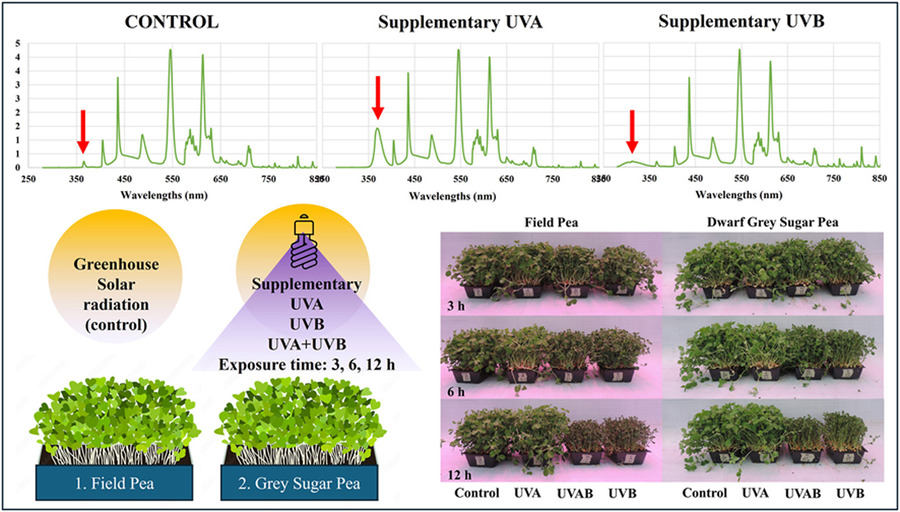
Abstract Although representing a small proportion of solar radiation, ultraviolet (UV) radiation (280–400 nm) has been shown to greatly affect growth, photomorphogenesis, and secondary metabolism in plants. Given the implications to crop physiology and nutritional quality, there is interest in understanding the effects of supplemental UVA and UVB radiation on the growth and phytonutrient content of nutrient-dense crops, like microgreens. We conducted a greenhouse study to evaluate the effect of supplemental UVA, UVB, and combined UVAB radiation on yield, mineral profiles, and antioxidant components of two varieties of pea (Pisum sativum L.) microgreens: ‘Field Pea’ and ‘Dwarf Grey Sugar Pea.’ After full germination, pea shoots were exposed to sunlight for one day and then were exposed to supplemental treatments of UVA (1.83 W/m 2 ), UVB (0.61 W/m m 2 ) + UVB (0.61 W/m 2 2 ), or UVA (1.55 W/ ) radiation for 3-, 6-, or 12-h/day for 6 days. The supplementary UVA treatment significantly increased fresh yield and dry weight in pea microgreens, with 12-h of UVA having the highest yield. Conversely, exposure to supplementary UVB and UVAB produced a loss in yield with all exposure times above 3- h/day. Exposure to UVA radiation had no significant effect on total phenolic content (TPC) and total antioxidant activity (TAA), while the exposure to UVB and UVAB radiation showed a significant decrease of both TPC and TAA with exposure times above 3-h/day. UVB supplementary radiation reduced pea shoot mineral accumulation, while UVA positively influenced mineral content only in ‘Dwarf Grey Sugar Pea’. These results suggest that exposure to supplementary UVB radiation (0.61 W/m 2 ) for longer than 3-h/day, regardless of the exposure to UVA radiation, results in significant losses in yield and antioxidant synthesis in pea microgreens.
|
-----------------------------------------------